Every coding agent starts from zero.This one starts from everything you’ve already decided.
ContextCode is the terminal coding agent wired straight into ContextStream. Your team’s decisions, corrections and lessons ground the plan before the first edit — and whatever this turn learns lands back in the same project context when it ends.
curl -fsSL https://contextstream.io/cs/install.sh | sh
The keyboard, and what the project knows.
Every turn opens by asking the workspace what is already known and closes by giving back what it learned. That round trip is the whole difference.
csc login approves the device in your browser. No API keys to paste, no config file to write.The same workspace every other assistant reads through the MCP server. ContextCode is the first-party path to it, not the only one.
Context was the only variable.
8 tasks against one repository, 3 trials per setup, every session fresh. Same Claude Sonnet 4.6, same prompts — the only change was whether project context was connected.
July 2026 · result of record
No loading-screen theatre.
Just the useful beats.
These are real isolated ContextCode sessions. Output is unchanged; idle model and tool time is removed so every clip resolves before attention does.
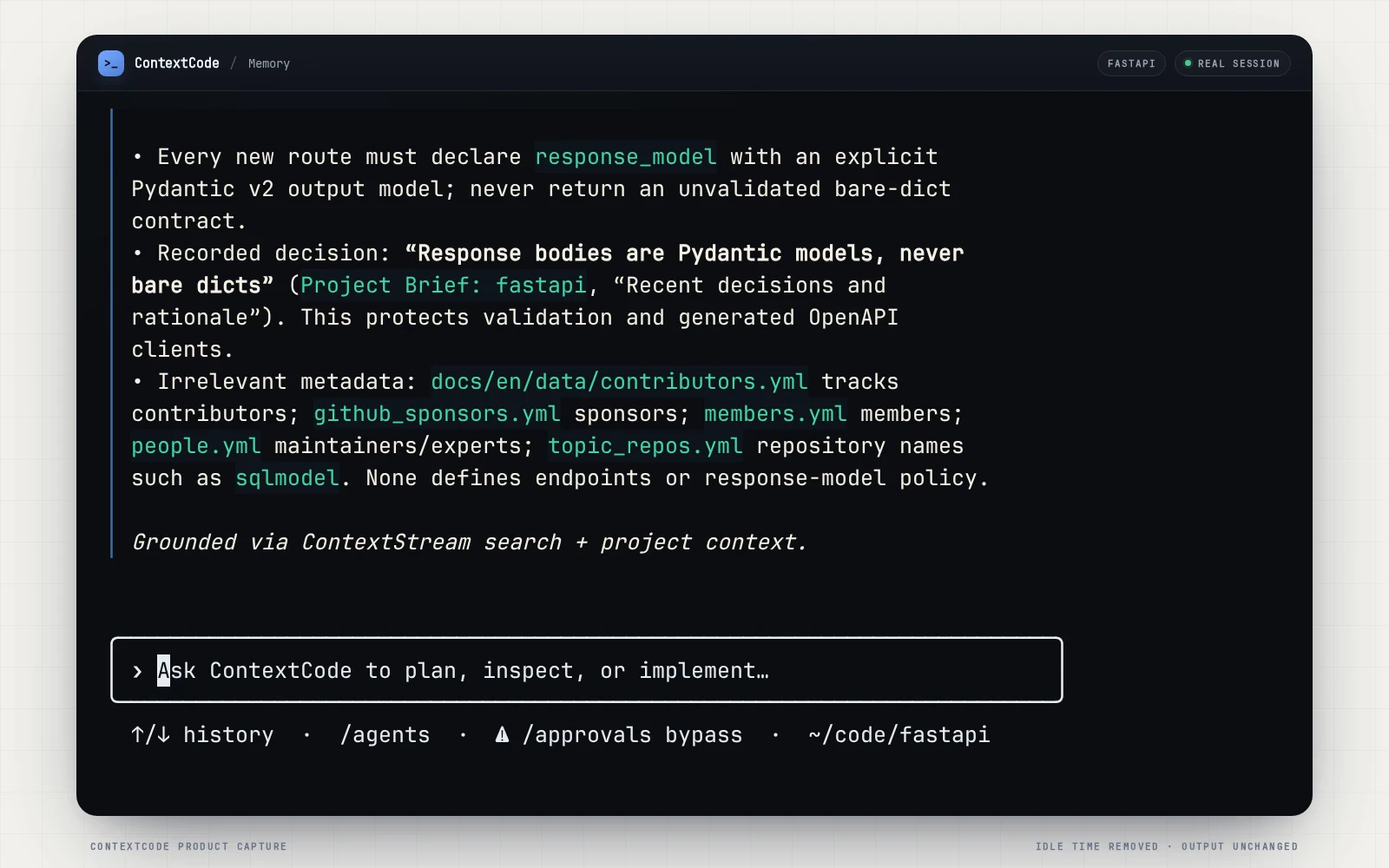
It answers from what your team decided.
A real ContextCode session in FastAPI. Three concise bullets, each grounded in the project decision behind it.
A teammate, not a text box.
Grounding is what makes the work good. These are the things it does with it.
A team, safely parallel
One goal, fanned out across coders, a reviewer and an integrator.
- Isolation
- a git worktree per agent
- Landing
- read the diff, Enter merges
Verified, not asserted
A real browser clicks through the feature the way a user would.
- Proof
- PASS or FAIL, with a screenshot
- Loop
- compiler errors feed the edit
Judged by your own rules
Plans and diffs are both measured against the decisions this repo is already bound by.
- Binding
- recorded decisions and lessons
- Verdict
- severity, file:line, the fix
The right model per step
Reasoning for the plan, a fast coder for the edit — routed for you.
- Override
- one keystroke, mid-session
- Cost
- your own keys run at zero
It runs your actual stack
Rust, Go, TypeScript, Python, Ruby, C# and PHP, with your real toolchain.
- Honest
- it probes a URL before citing it
- Search
- meaning-aware, not grep
Headless, in CI, over MCP
The binary you type into is the one your pipeline calls. No TTY, no prompts.
- Envelope
- one JSON object per run
- MCP
- a client, and a server
Convinced by the engine? Install it on one real repo and ask it something your code cannot answer.
Get ContextCode →Not an assistant. A staff.
Seven specialists, each with its own model, budget and permissions — bound in a JSON manifest rather than asked for politely in a prompt. Drop your own in .contextcode/agents/ and it resolves ahead of the built-ins.
- leadRuns the teamThe only specialist that can spawn others, and the one /orchestrate puts in charge.
- plannerDecides what to doFive tasks or fewer, no essays — grounded in the decisions, lessons and runbooks already recorded.
- coderImplements the changeRuns your real build and feeds its own failures back into its next edit.
- reviewerJudges the diffRead-only by construction — it cannot write a file, whatever a prompt asks it to do.
- explorerAnswers “how does this work?”Investigates code and project context at once, and surfaces the runbook that already answers the question.
- designerDesigns the interfaceGenerates real images, builds the screen, then opens a browser and looks at what it made.
- prototyperMakes it real, fastThe widest turn budget of any specialist, tuned for something you can click rather than read.
Where they diverge.
Claude Code and Codex CLI are both capable tools. The difference is what happens around the model — and it works here on day one.
| Capability | ContextCode | Claude Code | Codex CLI |
|---|---|---|---|
| Project context | |||
| Decisions and lessons that persist across sessions | Built in. Binding on every turn | Partial, or manual setup. Local files | Partial, or manual setup. AGENTS.md only |
| Context shared across machines and teammates | Built in. One workspace brain | Not available. Per-developer | Not available. Per-developer |
| Recall past sessions — “what did we decide?” | Built in. Indexed and searchable | Partial, or manual setup. Resume only | Partial, or manual setup. Resume only |
| Agents & isolation | |||
| Multi-agent orchestration with budgets | Built in. A dependency graph | Partial, or manual setup. Subagents, per prompt | Partial, or manual setup. Cloud tasks |
| Git worktree isolation | Built in. Default-on | Partial, or manual setup. Optional, agents only | Not available. Manual git |
| Review-first, one-key merge of agent work | Built in. Diff card → Enter | Not available. Merge it yourself | Not available. Merge it yourself |
| Verification | |||
| Browser verification with screenshots | Built in. Auto-provisioned | Partial, or manual setup. Via MCP you set up | Partial, or manual setup. Via MCP you set up |
| Self-correcting edits — compiler feedback | Built in. After every edit batch | Partial, or manual setup. Via hooks you write | Partial, or manual setup. Manual test runs |
| Models & pricing | |||
| Multiple frontier providers in one tool | Built in. Routed per step | Not available. Anthropic models | Not available. OpenAI models |
| Honest usage pricing | Built in. Pay for what you use | Partial, or manual setup. Weekly plan limits | Partial, or manual setup. Weekly plan limits |
All three ship MCP client and server modes, AGENTS.md, custom slash commands, skills, hooks, resume and continue, image paste, headless runs — the table is only where they diverge, and it reflects publicly documented capability as of July 2026. Both are excellent tools; if a cell looks out of date, tell us and we’ll fix it.
Same agent, three surfaces.
The dashboard and the desktop app are not reimplementations — they run the released binary. One project context, one credit balance.
Your terminal
The full agent — orchestration, worktrees, verification, review — as one static binary.
Read the docs →Your dashboard
The same released binary, driven from the web. Start a task at the keyboard and it is waiting here.
See the workspace →Your desktop
It bundles the binary too. Ask what the project decided without opening a terminal at all.
Download →Sixty seconds to grounded.
One static binary. No Node, no Python, no plugin. It works alongside VS Code, JetBrains, Neovim or whatever else you already have open.
curl -fsSL https://contextstream.io/cs/install.sh | shirm https://contextstream.io/cs/install.ps1 | iexcsc update keeps it current from signed releases.csc loginYour browser opens; approve the device. Done.csc in any repoYour first prompt is already grounded. Try /plan on something real./undo takes back any turn.Direct binaries and checksums
Explain it once. Let it compound.
The first plan you approve is already part of your team’s knowledge, and part of what the next agent starts from.